Design Insights
Teppichgrössen: Standardmasse und wann ein Sondermass sinnvoll ist
Creative Director and qualified architect, NEGRA Carpet & Home
Standard rug sizes are a convention of production, not a property of rooms. No living room was ever built so that 200 × 300 centimetres (6'7" × 9'10") would fit into it — that number comes from the loom, not from the floor plan.
None of which is a criticism. Standard sizes make rugs comparable, easy to stock and affordable, and in a great many rooms one of them fits perfectly well. It is simply worth knowing where the numbers come from. Once you do, it becomes much easier to tell when you are taking your bearings from them and when you are letting them narrow your options.
The sizes in common use
| Format | Area | Typical use |
|---|---|---|
| 60 × 90 cm 2' × 3' | 0.5 m² 5.8 sq ft | By the front door, beside the bed, in the bathroom |
| 80 × 150 cm 2'7" × 4'11" | 1.2 m² 13 sq ft | Bedside rug, small entrance area |
| 140 × 200 cm 4'7" × 6'7" | 2.8 m² 30 sq ft | Small living room, reading corner, in front of a sofa |
| 170 × 240 cm 5'7" × 7'10" | 4.1 m² 44 sq ft | The best-selling living room format |
| 200 × 300 cm 6'7" × 9'10" | 6.0 m² 65 sq ft | Seating group with front legs on the rug |
| 250 × 350 cm 8'2" × 11'6" | 8.8 m² 94 sq ft | Large seating group, small dining table |
| 300 × 400 cm 9'10" × 13'1" | 12.0 m² 129 sq ft | All furniture legs on the rug, large dining table |
| Ø 200 / 250 cm Ø 6'7" / 8'2" | 3.1 / 4.9 m² 34 / 53 sq ft | Round dining table, entrance hall |
Imperial equivalents rounded. Hand-knotted rugs are never exact to the millimetre: a rug sold as 170 × 240 may measure a few centimetres either way, and that is a property of the craft rather than a fault.
Two things are worth noticing about this table. The first is that the sizes jump. Going from 170 × 240 to 200 × 300 adds almost fifty per cent of area, and there is nothing in between. If your room falls squarely into that gap, you have to decide whether you would rather the rug were too small or too large.
The second is that the proportions are not constant. 140 × 200 is 1 : 1.43, 170 × 240 is 1 : 1.41, 200 × 300 is 1 : 1.5. Those differences are small enough to overlook on paper and large enough to settle the matter in a long, narrow room.
Measuring the right thing
Before any table is of use, you need to know which number you are looking for. The most common mistake in measuring is to measure the room instead of the area the rug is meant to occupy. Those are two different things.
Measure the furniture, not the walls. A rug belongs to the pieces that stand on it or around it. A living room five metres (16 ft) wide tells you very little about how wide the rug has to be if the seating takes up only three of those metres (10 ft). How far the rug then has to reach under the seating is the subject of the article on rug size for the living room.
Mark the area on the floor. Masking tape, newspaper, a bedsheet — anything that makes the outline visible. These five minutes are the one step that works reliably every time, because they show the area in the room where it will lie, in the light that falls there, with the furniture that stands there.
Check the doors. A rug lying under a door that opens inwards will foul it, and depending on pile height a few millimetres of build-up is enough to do it. This matters most for runners in a hall and for rugs near cupboard doors.
Write down two numbers, not one. A minimum below which the rug looks too small, and a maximum above which it overwhelms the room. The range between them is where you are searching — and more often than not, it contains more than one standard format.
How much floor should stay visible
Alongside the absolute size, a second thing decides the result: how much floor remains visible around the rug. That strip is not a leftover. It is a design element in its own right — it is the reason a rug reads as a deliberately placed piece rather than as badly laid flooring.
As a guide: 40 to 60 centimetres (16–24 in) of floor on every side is right in most living rooms. Less than 20 (8 in) and the rug starts to look like a failed wall-to-wall installation. Noticeably more than 80 (32 in) and it looks stranded — it no longer carries the furniture, it lies beside it.
In very small rooms this reverses. There, a rug reaching almost to the walls can make the room look larger, because the eye finds no interruption to trip over. The exception only works if you commit to it, though: stopping just short of the wall is the worst of the available options.
Runners and other formats
Runners follow a logic of their own. Their width is governed by walking, their length by the room. Common widths are 67, 80 and 100 centimetres (2'2", 2'7" and 3'3") in lengths from 150 to 400 cm (5 to 13 ft), and often cut to length from a roll.
In a hall, the rule is that the runner should leave at least ten, better fifteen centimetres (4–6 in) of floor on each side. A runner that reaches from wall to wall looks like a botched carpet fitting — the visible strip of floor is exactly what makes it legible as a deliberate choice. On length, the most frequent mistake is to let it end at a door: it should either stop well short of it or run well past it, never just barely reach it.
On stairs the question turns technical. There it is less about size than about fixing and slip resistance, and the geometry of the treads — winder stairs in older buildings above all — makes almost every staircase a case of its own.
When a standard size is enough
In most rooms, it is. That sentence belongs here precisely because the opposite claim is the convenient one for a rug house writing about bespoke sizes.
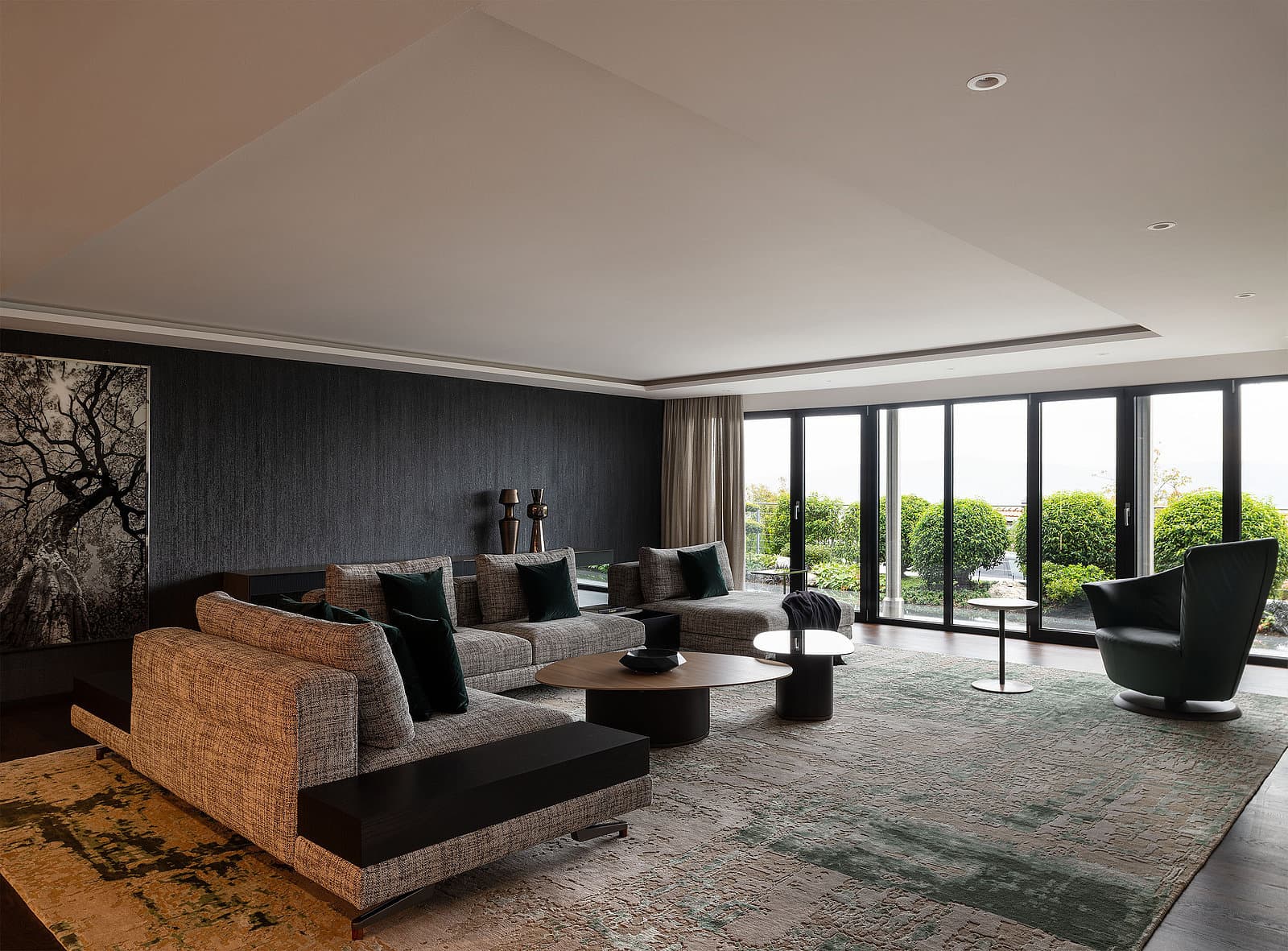
A standard format is the right choice when three conditions come together: the room is more or less rectangular, the furniture stands free in the space rather than against the walls, and the rug is meant to hold a seating group rather than line a room. That describes a very large number of living rooms.
There is more to it than that. Standard formats have two practical advantages that tend to get lost in a consultation. They are available now, and they are far easier to pass on. A 200 × 300 will find a place in the next flat, or with the next owner. A bespoke size cut to follow one particular wall is tied to that wall for good.
When it is not
There are four situations in which a standard format regularly leads to a compromise — and to the kind of compromise you keep noticing afterwards.
The room is not rectangular
A bay window, a sloping wall, a projecting chimney breast, an opening for the stairs — as soon as the area has a corner that is not a right angle, you have a choice between a rug that leaves space around that spot and one that follows it. The first always looks a little too small.
The transition is open
In open-plan layouts the rug takes over the job a wall used to do: it marks where one area stops and the next begins. For that to work, its edge has to sit where the zone actually ends — not where the next standard format happens to put it.
Older buildings are rarely square
Rooms in period buildings are seldom as rectangular as they look. A deviation of five centimetres over four metres (2 in over 13 ft) goes entirely unnoticed on a piece of furniture. On a rug edge that is meant to run parallel to the wall, it does not.
The rug has to sit under something specific
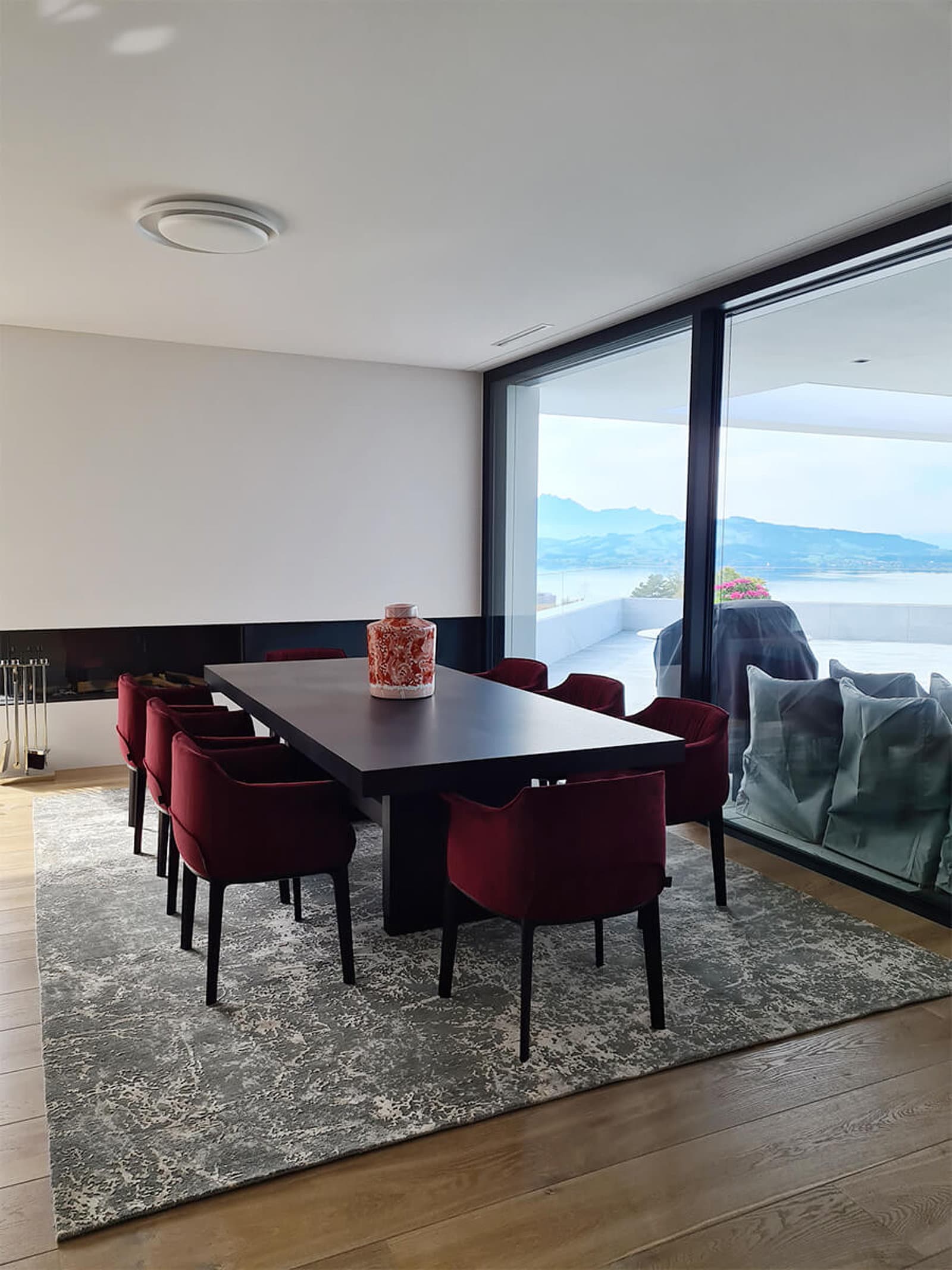
Under a dining table the size follows from the table and from the movement of the chairs — the arithmetic for that is in the article on rug size under a dining table. The results land between two standard formats almost every time.
The route to a bespoke size
A bespoke size is less involved than it sounds. The sequence is usually the same: measure, agree the format and the quality, look at samples, have it made. Production time is the real factor — a hand-knotted rug is made over months, not days. How that runs in detail is set out on the page on bespoke rugs.
Before any decision, though, standard or bespoke, the same thing applies: measure again, and mark the area on the floor. A strip of masking tape costs nothing and answers the question that every table on this page is only a substitute for. If you are still torn after that, the next step is to see the rug in the room itself — which is what trying a rug at home is for.