Design Insights
Teppichgrösse fürs Wohnzimmer: welches Format zu Ihrem Sofa passt
Creative Director and qualified architect, NEGRA Carpet & Home
People who are unsure which rug size fits their living room almost always choose too small. That is not a matter of taste — it follows from how we judge area. A rug unrolled in front of you looks large. The same rug surrounded by a sofa and two armchairs looks lost.
The good news is that this is not a question you have to settle by feel. There are three arrangements, and which one belongs in your room depends less on taste than on the floor area and how the seating is placed.
The three arrangements
All legs on the rug
The most generous version: sofa, armchairs and side tables stand entirely on the rug, with a strip of floor visible all around. The seating group becomes a self-contained island — the rug carries it rather than accompanying it.
This arrangement needs space. As a rule of thumb the rug should extend at least 20 centimetres (8 in) beyond the furniture legs on every side, better 30 (12 in). With a normal seating group you arrive at roughly 300 × 400 cm (10 × 13 ft) quickly — a size beyond the standard range of many houses. It works best in rooms from about 30 square metres (320 sq ft).
Front legs on the rug
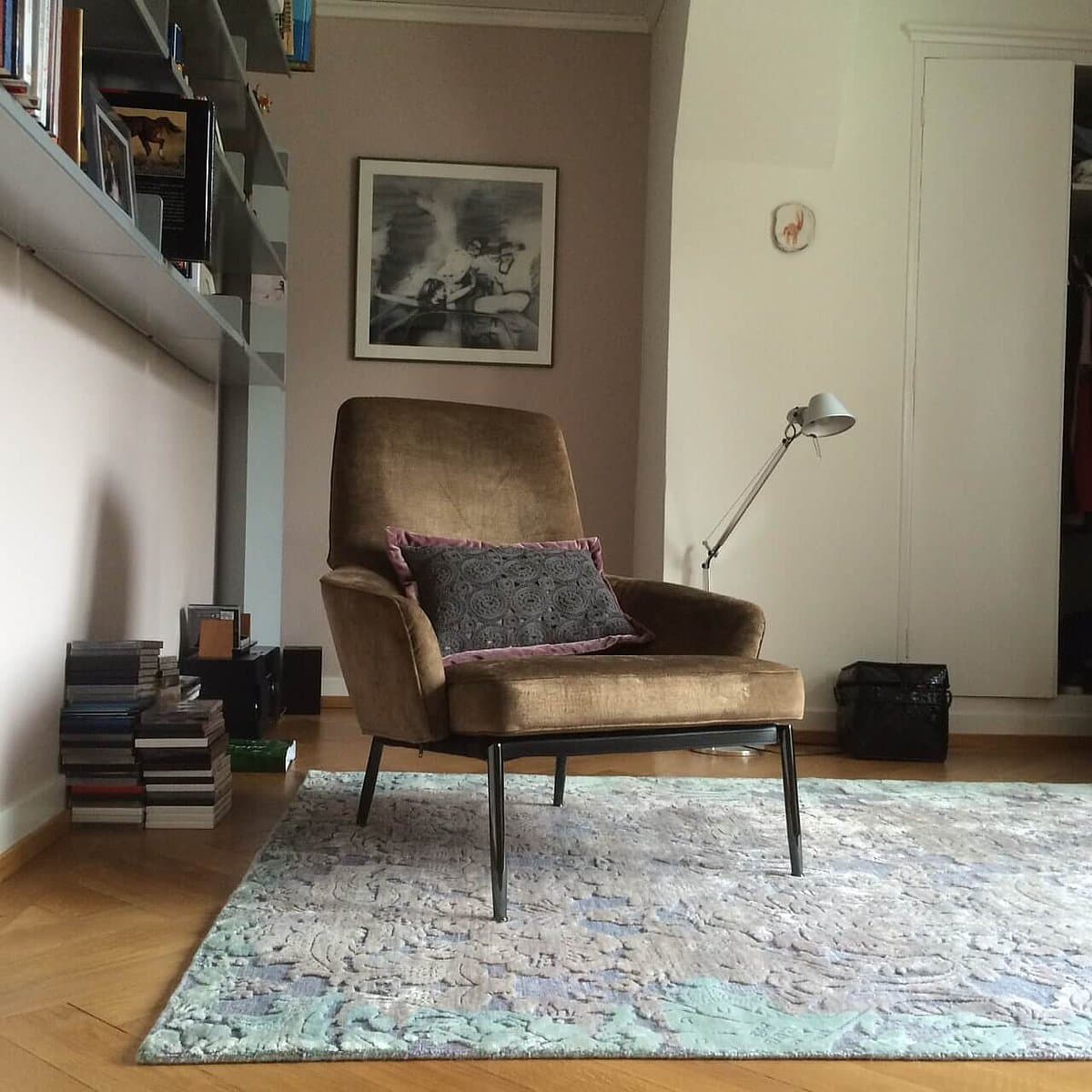
By far the most common solution, and the right one for most living rooms. Sofa and armchairs stand with their front legs on the rug and their back legs beside it. Visually this ties the seating together just as the first version does, at considerably less floor area.
Only one thing matters here: the rug must reach far enough under every seat that the front legs stand securely on it — a good 20 to 25 centimetres (8–10 in). If it only reaches up to the legs, you get exactly the restless impression you were trying to avoid.
The rug floats in front of the seating
The rug sits in front of the sofa without any furniture standing on it. This is the arrangement for small rooms — and the one most often chosen by accident, because it is what happens when the rug is simply too small.
Done deliberately it works: the rug then relates to the coffee table, not to the seating, and should be noticeably wider than that table. Done by accident it looks like a mat that has drifted into the middle of the room.
Guide sizes by sofa
| Seating | Front legs on | All legs on |
|---|---|---|
| Two-seater, no armchairs | 170 × 240 cm 5'7" × 7'10" | 200 × 300 cm 6'7" × 9'10" |
| Three-seater plus armchair | 200 × 300 cm 6'7" × 9'10" | 250 × 350 cm 8'2" × 11'6" |
| Corner sofa | 250 × 350 cm 8'2" × 11'6" | 300 × 400 cm 9'10" × 13'1" |
| Seating around a corner | 300 × 400 cm 9'10" × 13'1" | bespoke size |
Guide sizes. What matters in the end is the depth under the seating, not the format on the label.
One thing is striking about this table: from a three-seater onwards you leave the common standard formats behind. That is not a sales argument, it is arithmetic — standard sizes come from the loom, not from floor plans. Which formats exist and where the gaps are is covered in the overview of standard rug sizes.
The rug and the coffee table
Almost everyone plans the rug against the sofa. Almost nobody plans it against the coffee table — and that is the relationship you look at all evening, because the table sits in the middle of the rug and every glass, book and newspaper passes across it.
The measure is simple: the rug should extend clearly beyond the table on every side. Roughly 40 centimetres (16 in) all round is a sound working figure. That is not an aesthetic number. It is the distance you need in order to set a cup down at the edge of the table while standing or kneeling on the rug, rather than half on it and half on bare floor. Anyone who has caught a heel on the lip of a rug while carrying two glasses knows why the edge matters.
The failure case is a rug roughly the size of the table. It stops reading as a rug and starts reading as an underlay — a pad the table happens to be standing on, in a room that happens to have furniture around it. The proportion is the problem, not the piece: the same rug two sizes larger would carry the whole room.
In the floating arrangement the coffee table becomes the actual reference point, not the sofa. Measure the table, add 40 cm (16 in) on each side, and you have your minimum. Then check that result against the seating: the rug should still be at least as wide as the sofa it lies in front of, otherwise the group reads as two separate objects instead of one.
The distance to the wall
In a living room the border of bare floor does a specific job: it separates the seating island from everything around it — the bookshelf wall, the route to the kitchen, the doorway. Without that separation the group stops reading as a group.
As a guide: 40 to 60 centimetres (16–24 in) of floor on all sides is right in most living rooms. Less than 20 (8 in) and the rug looks like a failed carpet installation. Much more than 80 (32 in) and it looks stranded — it no longer carries the furniture, it lies beside it. The general rule behind those figures, and how it changes with room size, is set out in the overview of standard sizes.
There is a counter-intuitive consequence: a larger rug often makes a room look bigger, not smaller. A continuous surface gives the eye nothing to trip over, while several small islands cut the floor into pieces.
When the room is longer than it is wide
Most living rooms are not square. They are a rectangle with the seating at one end, and this is the floor plan on which standard formats perform worst — the standard range is built around ratios near 2:3, while rooms in flats are often closer to 1:2.
The rule is short: the rug takes the long axis. It should run in the direction the room runs, and it should be long enough that the length of the room reads as deliberate. In practice that means choosing 200 × 300 cm (6'7" × 9'10") over 250 × 250 cm (8'2" square), even when the square rug covers more floor. Area is not the quantity that matters here. Direction is.
A square rug in an elongated room does something specific and unhelpful: it shortens the room. The eye takes the rug as the measure of the floor, and a square measure laid into a long space cuts the length in two — the result feels both shorter and narrower than the room actually is.
Very narrow rooms are the interesting exception. Where the room is so tight that a border of floor along the long sides would amount to a few centimetres of nothing, a rug that takes almost the full width can open the room up instead: an uninterrupted surface gives the eye nothing to trip over. But this only works if you commit to it. Five to ten centimetres (2–4 in) to the skirting reads as intentional; 25 cm (10 in) reads as a rug that missed its size. Half-measures are worse here than either option carried through properly.
One rug or two
In a large living space — or one that runs into a dining area or a working corner with no wall between them — the question stops being about the seating group and becomes a question about the room. One rug across the whole floor, or one rug per use?
The short answer is one rug per zone, provided each zone really is one. A seating group and a dining table are two activities with two sets of furniture and two traffic patterns; a single rug underneath both has to meet two sets of requirements and usually meets neither, because dining chairs need clearance to be pushed back and a sofa does not.
What matters then is that the two rugs relate to each other without matching: the same family of colour in different patterns, or the same pattern at a different scale. Two rugs that are nearly identical look like an ordering accident; two with nothing in common cut the room into halves that have no relation to each other.
Where exactly to draw those zones, how much floor to leave between them and when a second rug does more harm than good is a subject of its own, worked through in zoning open-plan rooms.
When nothing fits
Some rooms simply do not accommodate a standard format: a bay window, a projecting fireplace, an open transition into the dining area, the slightly out-of-square geometry of an older building. In those rooms every standard size is a compromise, and it is a compromise you keep seeing.
A bespoke rug is then not a luxury decision but the obvious one. It is also less complicated than it sounds: measure, agree the format and quality, look at samples, have it made. The real factor is production time — a hand-knotted rug is made over months, not days.
Deciding without a screen
Everything above narrows the choice. It does not settle it, because two things cannot be judged from a photograph: how a colour behaves in your daylight, and whether a size feels right in your room.
The cheapest way to answer both takes five minutes and costs nothing: mark the intended area on the floor with masking tape, newspaper or a bedsheet, and live with it for an evening. If you are still undecided after that, seeing the rug in the room itself is the next step — that is what trying a rug at home is for. And if you would rather compare several qualities side by side first, the plain collections are a good starting point, because they show the size question without pattern distracting from it.