Design Insights
Teppich unter dem Esstisch: die Grösse richtig berechnen
Creative Director and qualified architect, NEGRA Carpet & Home
Under a dining table there is no question of taste. There is a movement — someone pushes their chair back to stand up — and the rug has to survive it. Everything there is to say about size follows from that one action.
That makes the arithmetic pleasantly unambiguous. Where a living room offers three different arrangements and the right one depends on the space (covered in the article on rug size for the living room), here there is one rule and one calculation.
The one rule
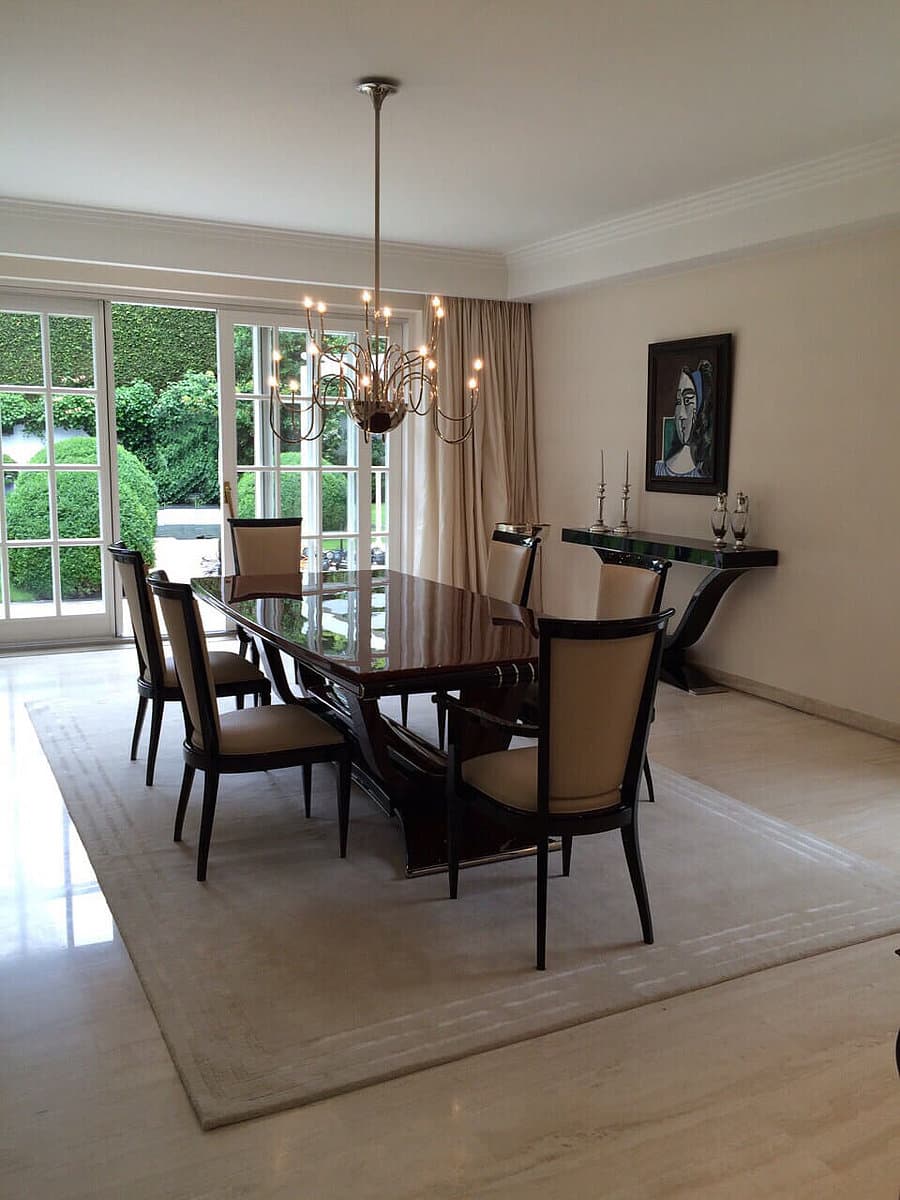
All four chair legs must stay on the rug when the chair is pushed back. Not the front legs, not just barely — all four, even when someone pushes well back to get up.
The reason is mechanical, not aesthetic. A chair leg that slips over the edge tips. It catches, the person sitting makes an involuntary movement, and over the years the edge wears through at exactly that point. A rug that is cut too short under a dining table does not become more attractive once you get used to it — it wears out faster, and in the most visible place.
The calculation
From the rule follows the formula: table size plus an allowance on every side. The only question is how large that allowance has to be — and there is a reason behind the number rather than a rule of thumb.
A normal dining chair is 45 to 50 centimetres (18–20 in) deep. To stand up it is pushed back 25 to 30 centimetres (10–12 in). The rear legs then sit a good 70 to 80 centimetres (28–32 in) from the table edge. For them to remain on the rug you need the same allowance — plus a small buffer, because nobody pushes back to the millimetre.
As a guide: 80 centimetres (32 in) on every side. With large carver chairs or deep upholstered seats, rather 90 (36 in). Less than 70 (28 in) only works with small, light chairs — and even then it is worth trying before you order.
| Table | Seats | Rug, minimum |
|---|---|---|
| 120 × 80 cm · 4'0" × 2'7" | 4 | 280 × 240 cm · 9'2" × 7'10" |
| 160 × 90 cm · 5'3" × 3'0" | 6 | 320 × 250 cm · 10'6" × 8'2" |
| 200 × 100 cm · 6'7" × 3'3" | 8 | 360 × 260 cm · 11'10" × 8'6" |
| 240 × 100 cm · 7'10" × 3'3" | 10 | 400 × 260 cm · 13'1" × 8'6" |
| 120 cm round · 4'0" dia. | 4–5 | 280 cm round · 9'2" dia. |
Guide sizes at 80 cm (32 in) allowance per side. Add 10–20 cm (4–8 in) for carver chairs or deep upholstery.
Note that these sizes lie almost entirely beyond what sits on a shelf. A 320 × 250 is already an unusual format; 360 × 260 and 400 × 260 more so. That is not a coincidence — it is why so many rugs under dining tables are too small. People take what exists rather than what fits. Which formats are common and where the gaps fall is covered in the overview of standard sizes.
What happens if you buy too small
Generous sizes cost more, so it is worth naming what you get instead when you drop one. Three things happen.
The edge goes first. A chair leg that crosses the border of the rug does not rest on it, it levers — pile pressed down on one side, leg riding up on the other, always along the same few centimetres (an inch or two). What gives way is the binding, the thread that closes the rug off along its outermost warp. Once that is chafed through, the last rows of knots work loose one at a time. Repairable, but on a rug that is too small the repair recurs.
The rug moves at every meal. A chair pushed back against a rug that ends under the table does not slide over it, it pushes it. Within a month it sits out of line, someone straightens it by hand, and that leaves ripples — a ripple under a chair leg carries the whole load on one raised line of knots.
And the room reads wrong. The eye takes the edge of a rug as a boundary and everything within it as one object. Chairs sitting half on and half off run that boundary through the group instead of around it, and the table appears to stand beside the rug rather than on it. Centring does not help: the fault is size, not position.
Those three consequences are why the figures in the table above are as generous as they are.
By table shape
Rectangular
The simple case: the rug takes the proportions of the table and grows by the same amount on all four sides. A rug noticeably narrower or wider in proportion than the table looks displaced even when it is centred.
Round
A round table suits a round rug best — diameter plus 160 centimetres (64 in), that is 80 on each side. A square under a round table also works, but only if the room is square enough that it does not read as a compromise. Round under rectangular rarely works.
Oval
Oval tables almost always stand in rooms where they are meant to save space. An oval rug doubles that effect but is realistically only available as a commission. The pragmatic answer is a rectangle whose corners stay free — that takes nothing away from the table.
Extendable — the case everyone forgets
An extendable table has two sizes, and the rug is nearly always bought for the smaller one. That is understandable, because the table stands that way most of the time. It goes wrong precisely when it matters: at Christmas, at a birthday, with twelve people — the evenings when someone is constantly getting up.
Calculate with the extended size. A rug that looks slightly generous day to day is a far smaller problem than one that catches chairs at every dinner party. If you cannot judge the difference, see the rug in the room before you decide — that is what trying it at home is for.
Round or rectangular — the effect in the room
Beyond the question of fit, the outline of the rug does something to the room.
A round rug under a round table calms a restless floor plan. A dining room already carries a great many straight lines — window reveals, sideboard, kitchen units, skirting, often a change of flooring as well. A circle joins none of them, and the eye reads the arrangement as one quiet island. The effect is strongest in a square or near-square room, where a circle sits centred without appearing to have been aligned to anything.
A rectangle does the opposite. Its edges run parallel to the walls and to whatever stands beside it, so it states a boundary rather than dissolving one. Where dining and sitting share an open floor, that is the more useful shape: the straight edge is what makes the dining area read as an area at all. More on that in the article on zoning open-plan rooms.
One test settles most cases: stand in the doorway. If the room reads as a grid of rectangles and feels hard, a circle is a relief; if the dining area keeps drifting into the sitting area, a rectangle draws the line. In a long, narrow room a large circle almost always loses — it leaves awkward slivers at both ends and looks as though it were floating.
Material and pile
Under a dining table you want a low pile. There are two reasons, and both come down to movement and dirt.
The first is the chair. The higher the pile, the more resistance it offers to being pushed. On a high-pile rug you are effectively lifting the chair rather than sliding it — which nobody does, so the legs plough through the pile instead. Along those tracks the pile lies permanently flat before long.
The second is the food. Crumbs fall into a deep pile and are hard to vacuum out again. On a densely knotted low pile they stay on the surface. The same goes for liquid: what sits on a dense surface can be blotted before it soaks in; what runs into a deep pile reaches the foundation.
On fibre: wool is the natural choice under a dining table, because the lanolin in the fibre repels liquid briefly rather than absorbing it at once. That window is short, but it often decides whether a glass of red wine stays an anecdote or leaves a mark. What to do in that moment is covered in the article on rug care at home — and what can still be recovered professionally on the page about rug cleaning.
The floor underneath
The rug is not the only thing being worked on here. What it lies on takes its share, and usually for a reason nobody expects.
On parquet and on natural stone, use an underlay — not primarily because the rug slips, but because chair movement drags it. Every push shifts it a few millimetres — a fraction of an inch — and beneath it there is always fine grit: sand carried in on shoes, mineral dust. Moved over that a few dozen times a day, the rug works as a sanding pad. On sealed oak that shows as a dulled patch long before the rug itself looks worn; on limestone or marble, worse — quartz sand is harder than either. A thin woven mesh stops the movement and adds almost no height. On oiled parquet, avoid the adhesive-coated kind.
On tiles the weak point is the edge. A rug edge lying across a grout line has nothing to settle into: it lifts slightly, a chair leg finds it, and the binding chafes against a mineral surface rather than a wooden one. Size the rug so that its edge falls well clear of the chairs — the same allowance as before, now for a second reason.
Underfloor heating adds rules of its own, and they can overrule the advice above: the thick foam mats sold for grip insulate about as much as the rug does. What that means in practice is set out in the article on rugs over underfloor heating.
Three common mistakes
Sizing to the room instead of the table. The rug under a dining table belongs to the table, not to the room. If the two cannot be reconciled because the room is too small, that is a sign the rug may not belong there at all.
Deciding from a catalogue photograph. Photographed dining rooms are usually larger than they appear, and the chairs are pushed neatly in. Neither is true in practice.
Centring the rug on the room rather than the table. If the table is not in the middle of the room — the norm in open-plan layouts — the rug has to travel with it. A rug aligned to the wall while the table is not looks like an oversight.
When no standard size fits
The table above leads, for most tables, to sizes that are not made as stock. That is the normal case and not a reason to drop to the next size down — on a rug loaded several times a day by chair movement, that shortcut costs you sooner than elsewhere.
A bespoke rug here is not a luxury decision but often the obvious one: it is made to the table size plus the allowance, and therefore fits exactly the one movement that matters. If you are unsure whether it is necessary, measure first — with the table extended, with a chair pushed back, and marked out on the floor with tape. Those five minutes answer the question more reliably than any table on this page.